Why use L4?
L4 helps improve access to justice
The L4 DSL stack improves access to justice and reduces the cost of developing legal software by giving non-lawyers a “low-code” way to explore and produce legal “programs”.
L4 helps people understand laws and contracts
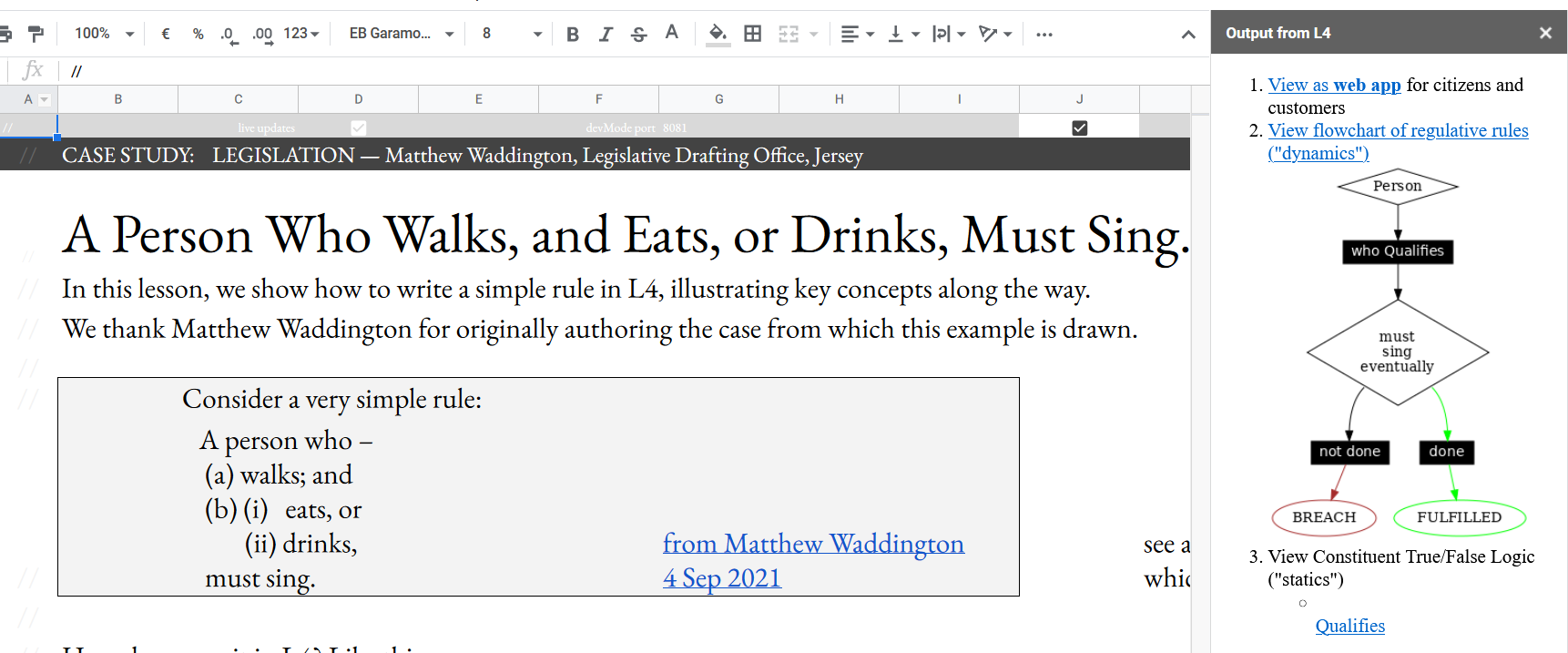
L4’s visualizers graphically depict the rules and logic of legal code to aid comprehension. (See: the ‘Must Sing’ example for ; or the ‘Home Insurance’ example)
L4’s scenario explorer helps engineers and end-users explore a contract by asking “what if?” and “can I?”.
L4’s explanation engine offers justifications for verdicts calculated by L4, for transparency.
L4’s planning engine helps end-users achieve goals by asking “how to?”.
L4 helps legal engineers draft with confidence
L4 is a DSL: a “low-code” domain-specific language designed for the legal domain.
The L4 ecosystem of tools, libraries, and sample code helps legal engineers get productive quickly without reinventing the wheel.
L4’s drafting IDE helps legal engineers draft and amend legal code with confidence, in a low-code programming environment, using techniques borrowed from programming language theory, compiler design, and formal methods.
L4’s ergonomic syntax is expressive enough to encode any contract and legislation using familiar keywords and a natural-language syntax
L4’s app builder automates the extraction of LegalTech apps without having to hire a team of developers for efficiency.
L4’s transpiler exports to a variety of third-party tools and languages for interoperability.
L4 helps enterprises manage their contracts
Enterprise users can integrate L4 into their existing contract lifecycle management systems to support more sophisticated “what if?” queries than their CLM databases allow.
L4 helps governments streamline service delivery
Government agencies innovating with “Rules as Code” can use L4 basis for automating the generation of citizen-facing web applications and chatbots.
L4 helps laypeople with a Web App
L4 automatically generates a web app that helps end users explore the logic of your legal code.
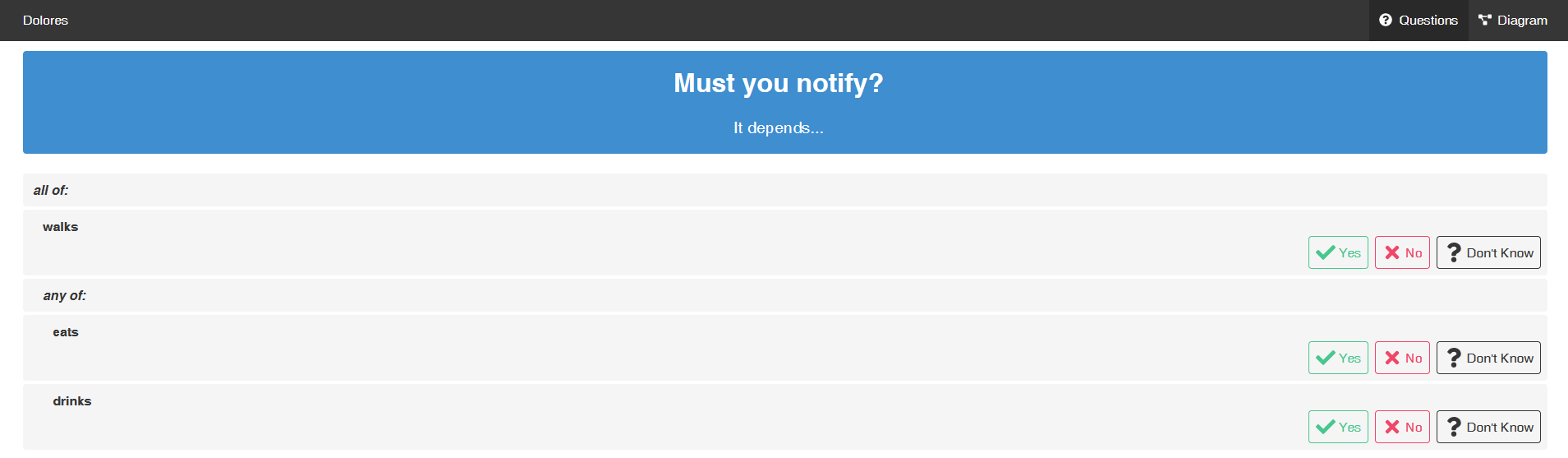
They can use this tool to understand if a law applies to them, or certain contractual conditions are met.
L4 helps you detect conflicts and loopholes
L4 sanity-checks your programs to detect internal conflicts and loopholes.
The “formal methods” components of the L4 toolchain automatically analyze your code for loopholes and inconsistencies.
L4’s unit testing framework lets you set up test scenarios and monitor them as your contracts evolve.
L4’s library of components makes it easier to draft legal templates and automatically produce legal documents for signature.
L4 helps you visualise legal logic
L4 generates convenient visualisations of the logic and the moving parts of your “legal program”.
To understand complicated logic involving words like “and”, “or”, “unless”: view the circuit diagram to see how yes/no verdicts depend on input facts.


To understand complicated processes involving deadlines and obligations: view the state diagram to see how events change state over time, leading to new obligations for parties. Identify a goal and see what you need to do to achieve it.
To understand complicated rule interactions like notwithstanding, subject to: view the meta-rule analysis to see how rules interact. (in development)
L4 can export to multiple formats
L4 code can be exported to languages such as Typescript (Javascript), Python, Prolog, and Haskell.
On the roadmap are other languages like OpenFisca, Catala, Epilog, and Accord. We prioritize these exporters according to demand so if there’s something you want on the list please contact us!
L4 uses spreadsheets for interaction
L4 is low-code. You don’t have to install VS Code, Emacs, or Vim. The IDE is Google Sheets: if you can edit a spreadsheet, you can program in L4.
L4 contains a package library
The L4 package library (currently in development) contains useful components such as
Calendars (knows about holidays, can count business days)
Money (knows about currencies)
Corporate (knows about directors, shareholders, meetings, resolutions)
Investment Agreements (convertible notes, SAFEs, and other instruments)
Insurance Policies (knows about risks, coverage, and supplementary add-ons)
Legislation and Regulation (knows about permitting and compliance)
L4 supports Document Assembly
The contract assembly engine helps you generate a document you can sign after running it past a lawyer for code review.
For investment agreements, L4 also generates all the prerequisite components such as board resolutions and members’ resolutions in writing.
L4’s PDF documents embed the code of the L4 contract for forward compatibility with contract lifecycle management tools.
The L4 package library will soon contain loan agreements, leasing agreements, and investment agreements.
L4’s answers are explainable
L4’s answers are explainable and transparent.
You can ask “why?”: Interactively drill down into every decision.
You can ask “how?”: if you state a goal you want to achieve, L4 will outline a course of action.
The Semantics of L4
This section outlines the semantic domains that support L4’s expressivity and generality.
The concepts introduced in this section are implemented throughout the L4 compiler toolchain.
Familiarity with the underlying ideas behind L4 is essential to any encoding exercise, just as familiarity with algorithms and data structures is essential to any programming exercise, and familiarity with jurisprudential notions of tort and liability is essential to any contract drafting practice.
Core Semantics: State Transition Systems
Legislation, regulations, and contracts prescribe processes for parties to obey: under certain conditions, a person must act in some way within some deadline; if they succeed, matters proceed one way; if they fail to act, matters proceed another way.
L4 models these legal and business processes as state transition systems. Related formalisms include BPMN, DFAs, Petri Nets, and hierarchical state machines (Harel statecharts).
In L4, regulative, aka prescriptive, rules have the syntax given below.
RegulativeRule      ::= ["UPON"        EventIdentifier]
                         "PARTY"       PartyIdentifier
                        ["IF"          ConditionExpression]
                         DeonticModal     ActionExpression
                        [TemporalModal  DeadlineExpression]
                        [SuccessTransition]
                        [FailureTransition]
                        ["WHERE"       LetBinding]

EventIdentifier     ::= ParamText

PartyIdentifier     ::= BoolStruct of ParamText

ConditionExpression ::= BoolStruct of Relational Predicates

DeonticModal        ::= "MUST" | "MAY" | "SHANT"

ActionExpression    ::= BoolStruct of ParamText

TemporalModal       ::= "BEFORE" | "AFTER" | "BY" | "ON"

DeadlineExpression  ::= Number ("days" | "weeks" | "months" | "years")
                      | AbsoluteDate

SuccessTransition   ::= ("THUS" | "HENCE" | "IF FULFILLED") (RuleName | RegulativeRule)

LetBinding          ::= DecisionRule+

RuleName            ::= String
The syntax for a DecisionRule is given below.
AbsoluteDate syntax is not given here, this is a can of worms to be explored elsewhere.
This syntax is intended to maintain isomorphism with legal source text which frequently has the form “upon receiving a demand for repayment, if the borrower is in default, the borrower must repay the outstanding principal plus any applicable accrued interest to the lender within five business days.”
Under the hood, that English text is trying to express a state transition. The L4 reorganizes the parts of the sentence according to a standard format.
  UPON  demand for repayment
    IF  borrower  IS  in default
 PARTY  borrower
  MUST  repay  the loan amount
           to  the lender
WITHIN  5  business days
 WHERE  DECIDE  the loan amount  IS  SUM  outstanding principal
                                          any applicable accrued interest
Double-spaces indicate column separations.
Concurrency presents a conceptual challenge. Many contracts and business processes describe multiple “moving parts”. If you’re juggling balls with your right hand while spinning plates with your left, each hand can be naturally modeled as its own state machine; but showing the system as a whole requires a product composition of every state on the left with every state on the right. L4’s treatment of this issue is given elsewhere in this documentation.
Core Semantics: Boolean Logic
L4’s decision logic is based on Boolean logic. Most programming languages offer an “if/then/else” construct. The “if” condition is Boolean-valued. It may rely in turn on numeric or other computation (e.g. 1024 >= 42) but the terms reduce to true or false.
L4’s basic Boolean operators, borrowed from propositional logic, are:
AND
OR
NOT
UNLESS (merely shorthand – “syntactic sugar” – for AND NOT)
L4’s list-oriented Boolean operators, borrowed from predicate logic, are:
ANY
ALL
Real-world use of L4 has shown that these operators are sufficent to represent large swathes of legal content – things to do with decisions.
In L4, operators and their arguments are grouped by indentation. In other languages, parentheses usually play this role; L4 relies on layout indentation instead due to “low-code” motivations.
Legal writing is often considered complex because a decision may involve many elements, spread out across multiple pages of text, separated across section references and “meta-rules” about applicability.
For example, parking regulations may say:
if it’s a weekend, section 2 applies;
if it’s a weekday, section 3 applies;
but if you’re previously obtained a special permit, section 4 applies notwithstanding sections 2 and 3.
All of these elements can be reduced to Boolean logic. L4 even automatically puts them in an “infographic” style diagram for easier comprehension.
Boolean Structures are used in the following positions in larger expressions:
In constitutive (Hornlike) rules:
in the left and right positions of a DECIDE … IF … pattern, which constructs Horn Clauses.
In regulative rules:
following an IF keyword.
following a WHO keyword
Detailed Definition of Boolean Structures
BoolStruct    a  ::=               UnaBoolStruct a
                     [BinaryBoolOp UnaBoolStruct a]
                     [...]
BinaryBoolOp     ::= AND | OR | UNLESS
UnaBoolStruct a  ::= NOT UnaBoolStruct

a                ::= RelationalPredicate
                   | ParamText
The a type is algebraic and in practice is filled by two types: RelationalPredicates and ParamTexts, described in detail below.
Note that L4 is whitespace-sensitive, so in the first definition above, the newlines are significant:
DECIDE |
output |
|
IF |
foo |
|
IF |
foo |
|
AND |
bar |
|
OR |
baz |
The remainder of this section focuses on the elemental RelationalPredicates and ParamTexts that can appear within the Boolean Structure, or BoolStruct for short.
Relational Predicates
In some places, the a type of a BoolStruct contains a Relational Predicate.
- Those places are:
in regulative rules, following an IF keyword.
in regulative rules, following a WHO keyword
in constitutive (Hornlike) rules, in the left and right positions of a DECIDE … IF … pattern, which constructs Horn Clauses.
There are five major subtypes of Relational Predicates.
RelationalPredicate ::= RPMultiTerm
                      | RPParamText
                      | RPConstraint
                      | RPnary
                      | RPBoolStructR
We define the semantics and give examples of each type below, in increasing order of complexity.
MultiTerms
The simplest form of RelationalPredicate is a sequence of cells all on the same line, containing either strings or numbers.
RPMultiTerm         ::= [MTExpression]
MTExpression        ::= MTT  string -- multiterm text
                      | MTI  number -- multiterm integer
In future, date, currency, and floating-point types may be added, using MTD, MTC, and MTF respectively.
PARTY you
  MAY buy beer
   IF you are over 21
input: |
you |
are |
over |
21 |
|---|---|---|---|---|
parses to: |
MTText you |
MTText are |
MTText over |
MTInteger 21 |
The Multiterm value [MTT you, MTT are, MTT over, MTI 21] is meant to be stringified to natural language and put to the end-user as a question in a user interface:
Are you over 21?
youAreOver21 :- userInput("you are over 21").
or perhaps, after natural language transformation,
youAreOver21 :- userInput("are you over 21?").
However, if the multiterm appears to the left of an IF in a DECIDE rule, it is acting as the head of a Horn clause, which means user input is not needed, because the answer will be computed by the body of the Horn clause. (User input may still be sought in a user interface that allows shortcut answering of parent nodes.)
youAreOver21 :- currentDate - birthDate > 21.
youAreOver21 :- dateDiff(currentDate, birthDate, (Y,M,D)), Y #> 21.
ParamTexts
The next simplest form is a sequence of cells with extra information on subsequent lines:
RPParamText          ::= ParamText

ParamText            ::= TypedMulti
                         [...]

TypedMulti           ::= MultiTerm  [TypeSig]

TypeSig              ::= IS A       TypeName
                       | IS ONE OF  MultiTerm
                       | IS LIST OF TypeName

TypeName             ::= String
input: |
PARTY |
alice |
|---|---|---|
MUST |
cook |
food |
with |
soy sauce |
|
without |
peanuts |
|
using |
a wok |
|
AND |
drink |
beverage |
without |
alcohol |
This matches the expressiveness of a Python function with named arguments:
cook(food, with="soy sauce", without="peanuts", using="a wok")
drink(beverage, without="alcohol")
(As of 0.9.4.3, L4 is limited to a single ParamText in the action phrase. The parser is being extended to support a boolstruct of paramtexts.)
When a ParamText is used inside a BoolStruct RelationalPredicate, the parameters are passed to the predicate:
The optional TypeSig is used to annotate the action, and its parameters, with type signatures.
The next more complex relational predicate involves explicit relation keywords:
RPConstraint ::= MultiTerm Relation MultiTerm
The relations and their semantics are given below:
Relation (keyword) |
semantics |
relation constructor |
|---|---|---|
IS |
equality |
RPis |
< |
less than |
RPlt |
> |
greater than |
RPgt |
<= |
less than or equal to |
RPlte |
>= |
greater than or equal to |
RPgte |
IN |
element is a member of a list |
RPelem |
INCLUDES |
a list contains an element |
(unimplemented) |
BEFORE |
date comparison |
RPTC TBefore |
AFTER |
date comparison |
RPTC TAfter |
BY |
date comparison |
RPTC TBy |
ON |
date comparison |
RPTC TOn |
The semantics of an RPConstraint predicate depend on the position where it appears.
example |
case |
Prolog semantics |
|---|---|---|
X IS Y |
“Y” is a term defined elsewhere in some constitutive (Hornlike) rule |
rpis(X,Y) :- y(X). Note that y(X) itself should be defined elsewhere and able to be expanded. See below remark about Expansion. |
X IS Y |
“X IS Y” is a predicate defined elsewhere in some constitutive (Hornlike) rule |
rpis(X,Y) :- X = Y. |
X IS Y |
Y is numeric |
rpis(X,Y) :- X #= Y. |
X IS Y |
Y is a member of an enum defined elsewhere |
rpis(X,Y) :- X = Y. |
X (<, >, <=, >=) Y |
Y is a defined term with numeric type and a computable value |
rpis(X,Y) :- X #< Y … X #> Y … X #=< Y … X #>= Y |
IN |
Y is a list type |
rpin(X,Y) :- memberchk(X, Y). |
INCLUDES |
a list contains an element |
rpincludes(X,Y) :- memberchk(Y, X). |
BEFORE, BY |
date comparison |
rpBy(X,Y), rpBefore(X,Y) :- X #< Y. % with some asDate typecasting as needed, implementation-dependent. |
AFTER |
date comparison |
rpAfter(X,Y) :- X #> Y. % with some asDate typecasting as needed, implementation-dependent. |
ON |
date comparison |
rpOn(X,Y) :- X #= Y. % with some asDate typecasting as needed, implementation-dependent. |
example |
case |
Prolog semantics |
|---|---|---|
PARTY P WHO Y |
“Y” is a term defined elsewhere in some constitutive (Hornlike) rule |
rpwho(X,Y) :- y(X). Note that y(X) itself should be either a ground term to be put to the user as a question, or defined elsewhere and able to be expanded. |
A WHO limb in a regulative rule implicitly uses the PARTY as the subject of the rule.
The IS relation is substituted implicitly; other relations are not available. If you want to use other relations, use an explicit IF and name the party explicitly.
example |
case |
Prolog semantics |
DECIDE X IS Y |
there is no IF part |
y(X) :- true. |
DECIDE X IS Y IF … rhs … |
Y is numeric |
rpis(X, Y) :- … rhs … |
DECIDE X IS Y IF … rhs … |
Y is non-numeric |
rpis(X, Y) :- … rhs … |
example |
case |
Prolog semantics |
DECIDE foo IF |
there is no IF part |
y(X) :- true. |
DECIDE X IS Y IF … rhs … |
Y is numeric |
rpis(X, Y) :- … rhs … |
DECIDE X IS Y IF … rhs … |
Y is non-numeric |
rpis(X, Y) :- … rhs … |
input: |
foo |
bar |
IS |
123 |
|---|---|---|---|---|
parses to: |
MTText foo |
MTText bar |
RPis |
MTInteger 123 |
RPConstraint ::= RPMultiTerm RPRelation RPMultiTerm
input: |
foo |
bar |
IS |
123 |
|---|---|---|---|---|
parses to: |
MTText foo |
MTText bar |
RPis |
MTInteger 123 |
RPnary
RPnary constructors are the most general form of expression; in fact they are s-expressions.
RPnary ::= Relation (List of Relational Predicates, newline-separated)
This allows us to say things in a Lispy form, like (SUM 1 2 (MAX 3 4)).
The permitted relational operators are as in the Constraints table above, plus
Relation (keyword) |
semantics |
relation constructor |
|---|---|---|
&& |
all are true |
RPall |
|| |
any are true |
RPany |
MTText foo |
MTText bar |
MTInteger 123 |
RPBoolStructR
This form is too heavyweight and is likely to be deprecated.
Expansion
Constitutive (Hornlike) rules define Relational Predicates, which can then be expanded at the points of use.
For example:
DECIDE you may pass
    IF horse IS NOT made of coconuts
   AND bird  IS swallow

DECIDE bird  IS swallow
    IF bird  IS African swallow
    OR bird  IS European swallow
Semantically, we may think of the first rule as desugaring to:
youMayPass :- \+ madeOfCoconuts(horse), swallow(bird).
The second rule desugars to
swallow(bird) :-  africanSwallow(bird).
swallow(bird) :- europeanSwallow(bird).
In a transpiler toolchain which does not operationally rely on Prolog directly, the same expansion can be performed by the Interpreter component or by the transpiler itself. The current LS/XPile/Interpreter.hs does perform the equivalent expansion transformation, relying on equational reasoning to substitute as though the encoding had originally written:
DECIDE you may pass
    IF horse IS NOT made of coconuts
   AND     bird IS African swallow
       OR  bird IS European swallow
If the rest of the ruleset is silent about the further technicalities of what constitutes an African or European swallow, the question of europeanSwallow(bird) becomes a ground predicate which is put to the user for input.
Classifiers and Output Categories
Suppose: if you were going less than 20km/hr over the limit, one penalty applies; if you were going more than 20km/hr over the limit, another penalty applies.
These are, essentially, switch statements writ large. A theoretician might say that law reintroduces shades of gray to black-and-white decisions by specializing decision outcomes based on real-valued logic. More on this in our section on decision tables and trees.
Here’s how we express the speeding penalties in L4:
DECIDE penalty IS none     IF excess speed <=   0    km/hr
"     "        "  warning     "  "         <=  20    km/hr
"     "        "  small fine  "  "         <=  40    km/hr
"     "        "    big fine  "  "         <=  60    km/hr
"     "        "  time travel "  "         IS 141.62 km/hr
"     "        "  jail        "  "         >   60    km/hr
To illustrate the IS keyword, we’ve added a special case for cars moving at exactly 88 miles per hour.
In predicate logic notation, we rewrite the above L4 rules to:
penalty(ExcessSpeed, warning    ) :- ExcessSpeed =< 20.
penalty(ExcessSpeed, smallFine  ) :- ExcessSpeed =< 40.
penalty(ExcessSpeed, bigFine    ) :- ExcessSpeed =< 60.
penalty(ExcessSpeed, timeTravel ) :- ExcessSpeed IS 141.62.
penalty(ExcessSpeed, jail       ) :- ExcessSpeed >  60.
To the left of the IF keyword, the IS keyword creates a predicate relation, defining the penalty predicate as a relation between excess speed and the output variable which ranges from a warning to jail.
To the right of the IF keyword, an IS keyword is treated as value equality, similar to == in Javascript or Python or other languages.
The details of the syntactic transformation are given separately in Prolog Transpiler Documentation.
CS Sidebar: For now, we note that such decisions have type Classifier = [(E2B,Category)] -> Environment -> Category. Given some preconfigured mapping of Boolean case to outcome category, given some specific environment, a classifier returns the penalty that applies in this case.
Operational Semantics: L4 builds on the essential semantics of Prolog. Negation as failure and the closed world assumption are relevant. Upcoming Prolog Transpiler Documentation will address what this means in practice. There are some other minor edge cases: for example, even in classical logic, it is possible for both a statement and its seeming “opposite” to be true. (See vacuous truth). In practice these do not present major concerns for L4.
Unknown Values
In a perfect world, Boolean values have one of two values: true or false. In the real world, variables are sometimes unknown: to reflect missing information and optional values.
For example, if a user filling out a form did not give their birthdate, then the perfectly reasonable yes-or-no question “Is the user over 21?” cannot be answered with a true or false value!
In practice, a JSON structure might omit the birthdate attribute, so it is undefined; an over21() method might return a value of null. Either way, these neither-true-nor-false values demand a ternary logic <https://en.wikipedia.org/wiki/Three-valued_logic>_ that goes beyond the underlying foundational logic.
In the simple case of a web form, we could slap input validation on the birthdate field, and make it the user’s job to always give a date.
Real-world scenarios often present unknown values. SQL databases may have columns which are typed boolean, but without a NOT NULL constraint, allowing three values, not two.
In delicate situations we might want to omit a line of questioning if it is unnecessary or irrelevant: “birthdate, fine, but do you really need to know my race?”
“We’re only asking because certain discounts might be available if …”
“Never mind the discounts, let’s just skip past that question, shall we? Especially since the biggest discounts apply to someone over 65, which I am, regardless of race.”
CS Sidebar: A typed language might deal with these possibilities by explicitly using an Optional<Boolean> type. In L4, all ostensibly Boolean values are automatically wrapped in Optional, to anticipate missing-data scenarios. The specific variant of ternary logic used in L4 evaluation is from Łukasiewicz’s Ł3 logic.
Footnote: Abducible Variables
Abducible variables are variables whose values “rise to the occasion”: for example, a quadratic equation y = x^2 - 4 might have two roots: at the occasion y = 0, one solution that arises is x = 2; but another solution is x = -2. So x doesn’t have one just value: in this equation it has two. For some other value of y, though, x migth have one solution; or even none.
Similarly, in some legal scenarios, people might say, “well, without knowing the specifics” – not knowing the exact value of y to solve for – one can still make certain assertions. For example, you could give your answer as an inequality: south of -4 on the y axis, there are no solutions at all, no values of x which satisfy the formula
For example: the rules might say, if it’s a weekend, you can park for free after 12pm; if it’s a weekday, you can park for free after 6pm. That allows some amount of reasoning: if you’re just looking to park at 8pm, that’s always free; but if you want to park at 10am, we need to know which day of the week you’re looking at before we can tell you if you need to buy a ticket.
How is this relevant to L4 developers? 99% of the time, you won’t need to worry about this: L4 figures out abducible variables on its own and presents them intelligently in the course of deriving an answer set. This is documented so an L4 internals engineer can understand how L4’s semantic model supports abductive reasoning.
Math sidebar: y = x^2 - 4 has no solutions … unless we’re allowing x to be an imaginary number, in which case we give 2i, -2i as the answer. See? Even in mathematics, “it depends”.
Predicate Expressions
All decision expressions are reducible to Prolog predicates, and conform to the semantics of those predicates.
Note that Prolog is slightly order-dependent, in that if the user terminates a query after the first answer, order matters.
Modal Expressions
L4 uses special keywords to identify the following classes of modal expressions:
- deontic
MUST
MAY
SHANT
- temporal
BEFORE
AFTER
WITHIN
BY
- epistemic
BELIEVES
KNOWS
NOTIFY
- causal
CAUSES
DUETO
- power
PROCURE
PROVIDE
These modals reduce to the core forms of L4 expressions: Boolean Logic, and State Transition Systems.
For example, a contract might say: if Party P1 comes to believe that some event E1 has occurred, which was caused by an event E2, then Party P1 must procure that its subsidiary P1A must notify Party P2 within 5 working days.
The triggering state transition is that Event E1 happened.
The “outcome” is the procurement of a notification to P2. It has to be procured because P1 controls P1A, but P1A is not a party to the contract, so P1 has to kick off some internal process to make sure P1A carries out the notification.
The condition is that Event E1 was caused by Event E2.
 UPON E1
   IF E2 CAUSED E1
PARTY P1
 MUST PROCURE    PARTY P1A
                  MUST NOTIFY P2
Here we see that the PROCURE keyword is a unary operator of type Regulative Rule -> Action so it can return as the argument to the MUST keyword.
Those expressions that reduce to Boolean logic are rewritten to predicate form:
causes(E2, E1, ...) :- ....
Sometimes the system has enough information to compute causation. If, for example, E2 and E1 are explicitly connected in some state transition sequence, and the history of the contract (the “trace”) shows that E2 preceded E1, and the reasoner is satisfied that E1 would not have happened if E2 had not happened, then that predicate would be computed as satisfied:
causes(E2, E1, ...) :- matchTrace(ContractHistory, precedes(E2, E1)).
Other times, human input is required, and the expression reduces to a query in some interactive UI.
causes(E2, E1, ...) :- userInput(["did", E2, "cause", E1]).
How is CAUSED as a keyword different from caused as a lower-case term? In the latter case, where user input is required, there is no difference – if the encoding had used caused, lower case, L4 would transpile exactly the same relation. The only difference is that L4 would not example the contract trace to automatically determine causation.