L4 Language Specification¶
This L4 language specification is for L4 developers.
There is a page on understanding L4 through the law here: Use Law to Understand L4.
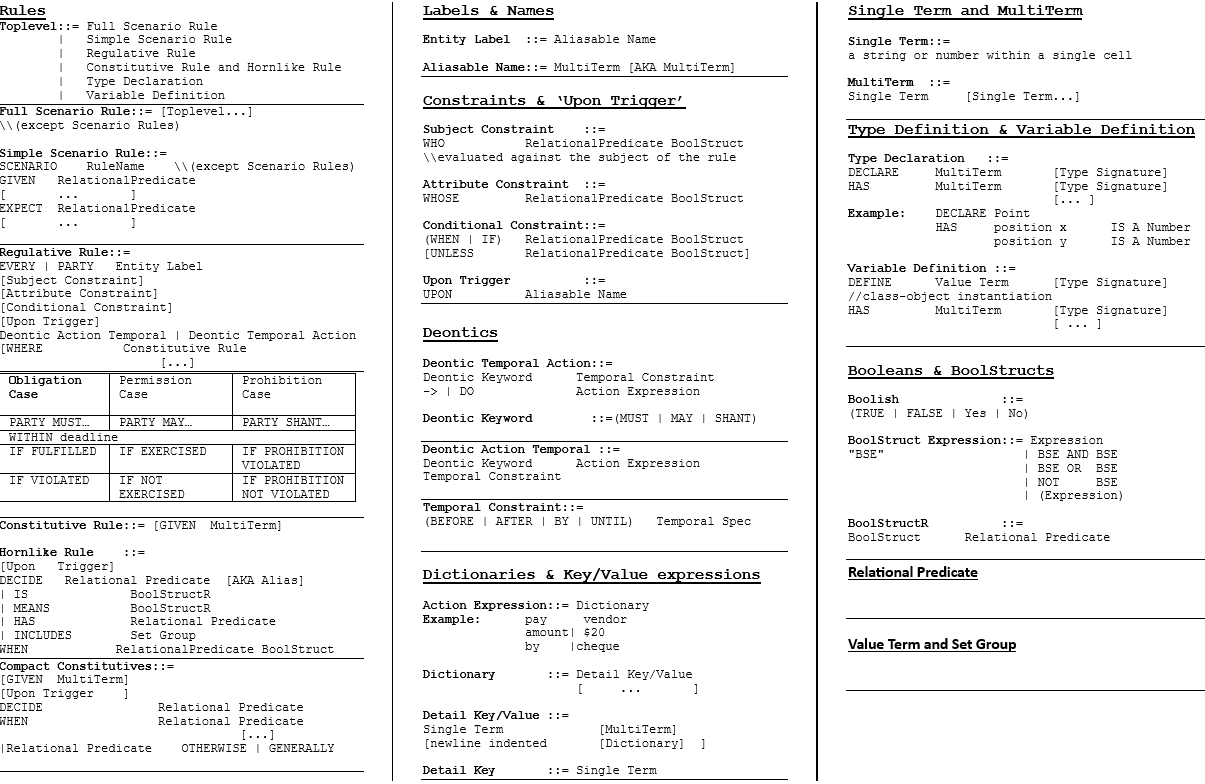
- Generic L4 constructs
Types of Expressions in L4¶
This Backus-Naur Form (BNF) specification describes the generic syntax of the L4 language.
Top Level¶
Toplevel::= Full Scenario Rule
        |   Simple Scenario Rule
        |   Regulative Rule
        |   Constitutive Rule and Hornlike Rule
        |   Type Declaration
        |   Variable Definition
Rules¶
Full Scenario Rule¶
Full Scenario Rule::=       [Toplevel...] \\(except Scenario Rules)
                            \\this allows us to reduce the ruleset as more and more data is available
Simple Scenario Rule¶
Simple Scenario Rule::=     SCENARIO    RuleName    \\(except Scenario Rules)
                            GIVEN   RelationalPredicate
                                    [       ...       ]
                            EXPECT  RelationalPredicate
                                    [       ...       ]
Regulative Rules: EVERY, WHERE¶
Regulative Rule     ::=     EVERY | PARTY   Entity Label
                                    [Subject Constraint]
                                    [Attribute Constraint]
                                    [Conditional Constraint]
                                    [Upon Trigger]
                                        Deontic Action Temporal | Deontic Temporal Action
                                    [WHERE           Constitutive Rule
                                                            [...]                           ]
Regulative Rules: MUST, MAY, and SHANT¶
Obligation Case ::= PARTY     MUST               ...
                    WITHIN    deadline
                    IF FULFILLED                 ...
                    IF VIOLATED                  ...

Permission Case ::= PARTY     MAY                ...
                    WITHIN    deadline
                    IF EXERCISED                 ...
                    IF NOT EXERCISED             ...

Prohibition Case ::= PARTY    SHANT              ...
                     WITHIN   deadline
                     IF PROHIBITION VIOLATED     ...
                     IF PROHIBITION NOT VIOLATED ...
Constitutive Rule and Hornlike Rule¶
Hornlike clauses have the form: Head if Body
Constitutive Rule ::= [GIVEN  MultiTerm]
Hornlike Rule     ::= [Upon   Trigger  ]
                        DECIDE          Relational Predicate  [AKA Alias] [Typically Boolish]
                      | IS              BoolStructR
                      | MEANS           BoolStructR
                      | HAS             Relational Predicate
                      | INCLUDES        Set Group
                        WHEN            RelationalPredicate BoolStruct
Compact Constitutives¶
Compact Constitutives ::= [GIVEN        MultiTerm]
                          [Upon Trigger          ]
                          DECIDE        Relational Predicate    WHEN        Relational Predicate
                                                                            [ ... ]
                                    |   Relational Predicate    OTHERWISE | GENERALLY
Labels and Names¶
Entity Label    ::= Aliasable Name

Aliasable Name  ::= MultiTerm [AKA MultiTerm]
// in future – extend to BoolStruct of SetGroup
Constraints and ‘Upon Trigger’¶
Subject Constraint      ::= WHO             RelationalPredicate BoolStruct
\\evaluated against the subject of the rule

Attribute Constraint    ::= WHOSE           RelationalPredicate BoolStruct

Conditional Constraint  ::= (WHEN | IF)     RelationalPredicate BoolStruct
                            [UNLESS         RelationalPredicate BoolStruct]
Upon Trigger ::= UPON Aliasable Name
Deontics¶
Deontic Temporal Action     ::=     Deontic Keyword             Temporal Constraint
                                    -> | DO                     Action Expression

Deontic Keyword             ::=     (MUST | MAY | SHANT)
A semantically equivalent syntactic alternative allows the temporal keyword to line up with the other keywords:
Deontic Action Temporal ::= Deontic Keyword            Action Expression
                            Temporal Constraint
Temporal Constraint ::= (BEFORE | AFTER | BY | UNTIL) Temporal Spec
Dictionaries and Key/Value expressions¶
Action Expression   ::= Dictionary
example                     pay     vendor
                            amount| $20
                            by    |cheque

Dictionary          ::= Detail Key/Value
                        [     ...       ]

Detail Key/Value    ::= Single Term             [MultiTerm]
                        [newline indented       [Dictionary]  ]

Detail Key          ::= Single Term
Single Term and MultiTerm¶
Single Term         ::= a string or number within a single cell

MultiTerm           ::= Single Term     [Single Term...     ]
Type Declaration and Variable Definition¶
Type Declaration    ::= DECLARE     MultiTerm       [Type Signature ]
                        HAS         MultiTerm       [Type Signature ]
                                                    [ ... ]
example                 DECLARE     Point
                        HAS         position x      IS A Number
                                    position y      IS A Number

Variable Definition ::= DEFINE      Value Term      [Type Signature] //class-object instantiation
                        HAS         MultiTerm       [Type Signature]
                                                    [ ... ]
Booleans and BoolStructs¶
Boolish              ::= (TRUE | FALSE | Yes | No)

BoolStruct Expression::= Expression
"BSE"                   | BSE AND BSE
                        | BSE OR  BSE
                        | NOT     BSE
                        | (Expression)

BoolStructR          ::= BoolStruct      Relational Predicate
Relational Predicate¶
Value Term and Set Group¶
Syntax Reference by Keyword¶
WHOSE¶
WHOSE in a regulative rule¶
The “WHOSE” keyword can appear at the top level in a regulative rule, where it acts as a qualifier constraint.
EVERY   P
WHOSE   attribute   predicate               [TYPICALLY Boolean-expression]
WHOSE   color   IS  blue
The WHOSE line adds a precondition to the rule. If the WHOSE block does not return a true result, the rest of the rule does not proceed.
The attribute term is interpreted with respect to the party P.
The predicate takes up the rest of the line and applies to the attribute. As with most predicates, a TYPICALLY default can be supplied to improve UX.
This is operationally equivalent to:
function rule (..., party, attribute, value,... ) {
    if (! predicate(party[attribute]) { return }
}
and is logically equivalent to (See swipl dicts for syntax):
rule(…, Party, Attribute, Predicate, ...) :-
call(Predicate, Party.Attribute), ...
WHOSE in top-level constitutive definitions¶
The “WHOSE” keyword can appear in a top-level constitutive definition, where it acts as a qualifier constraint.
DEFINE      Retriever
IS A        Dog
WHOSE       Breed   IS IN   Chesapeake Bay          Golden
                            Curly-Coated            Labrador
                            Flat-Coated             Nova Scotia Duck Tolling
A Retriever is a Dog whose attribute Breed matches one or more of the elements given in the following list.
If the Breed attribute is itself a list, then the test is a set intersection.
If the Breed attribute is not defined, the test is negative.
See remarks about vacuous truth.
WHOSE in inline constitutive definitions¶
The “WHOSE” keyword can appear in an inline constitutive definition in a regulative rule, where it acts as a qualifier constraint.
EVERY   Dog Walker
MUST    muzzle  their   Dog
                        WHOSE   Breed   IS IN   Pit Bull
                                                German Shepherd
Assuming the MUST does not contain any AND or OR branches, this is effectively similar to saying, at the top level,
WHEN Dog Breed IS IN Pit Bull German Shepherd
Because the WHOSE does not appear under an AND/OR/XOR limb, the qualifier attaches to the top-level rule, and voids the entire rule if the constraint is not met.
WHOSE in a junction list¶
The “WHOSE” keyword can appear under a limb of a junction list, where it acts as a qualifier constraint on the associated limb.
        Motorcycle
MEANS   Two-wheeled     vehicle     equipped with an    internal combustion engine
OR      Two-wheeled     vehicle     equipped with a     battery-powered motor
        WHOSE           maximum speed   >               11  miles per hour
Because the WHOSE appears under an AND/OR/XOR limb, the constraint is ANDed within the nearest limb.
Internally, with the help of some DEFINE rules (shown below) the rule is transformed to:
    Motorcycle
MEANS       vehicle wheel count             IS      4
OR          vehicle wheel count             IS      2
    AND     vehicle engine                  IS      internal combustion engine
    AND     vehicle maximum speed           >       11 miles per hour
WHO¶
WHO in a regulative rule¶
The “WHO” keyword can appear at the top level in a regulative rule, where it acts as a qualifier constraint.
EVERY       P
WHO parameterizable attribute
The WHO line adds a precondition to the rule. If the WHO block does not return a true result, the rest of the rule does not proceed.
The parameterizable attribute term is interpreted with respect to the party P.
This is operationally equivalent to:
function rule (…, party, attribute, …) {
    if (! party.attribute) { return }
}
and is logically equivalent to:
rule(…, Party, Attribute, …) :-
call(Verb, Attribute), ….
There is some subtlety here: sometimes an attribute turns out to be a method, meaning a function that runs against the party, with arguments.
In other words, you might want:
function rule (…, party, attribute, attributeParameters, …) {
    if (! party.attribute( attributeParameters )) { return }
}
The arguments are given as a dictionary of sub-attributes and predicates:
EVERY   P
WHO     attribute
            sub-attribute   predicate
            sub-attribute   predicate
This enables the more natural phrasing:
EVERY   P
WHO     runs
        with        scissors
        speed       >3 mph
DEFINE¶
DEFINE      F
GIVEN       P1      P2      P3

DEFINE      F1      F2
MEANS       something possibly involving F1 and F2

DEFINE              two-wheeled vehicle
MEANS               vehicle wheel count     IS   2

Note that the indentation follows the first word of the rewritten phrase.

DEFINE              vehicle equipped with an      X
MEANS               vehicle drive           IS    X
Note that you get a/an-equivalence for free, when it appears at the end of a cell, as above.
When a rewrite rule operates twice against the same sentence, on both the left and the right of the central term, the limbs are conjoined with an AND and reindented accordingly.
AS IN¶
This keyword is shorthand for importing a particular keyword block from another section.
Suppose we have:
§       Section One
PARTY   Seller
WHEN    sale        date    IS IN   promotional period
AND     sale        store   IS IN   stores participating in promotion
AND     blah        blah
MUST    do something
Rather than repeat all the WHEN bits,
§   Section Two
PARTY   Buyer
WHEN    AS IN       Section One
MUST    do something else