Why use L4?
L4 helps improve access to justice
The L4 DSL stack improves access to justice and reduces the cost of developing legal software by giving non-lawyers a “low-code” way to explore and produce legal “programs”.
L4 helps people understand laws and contracts
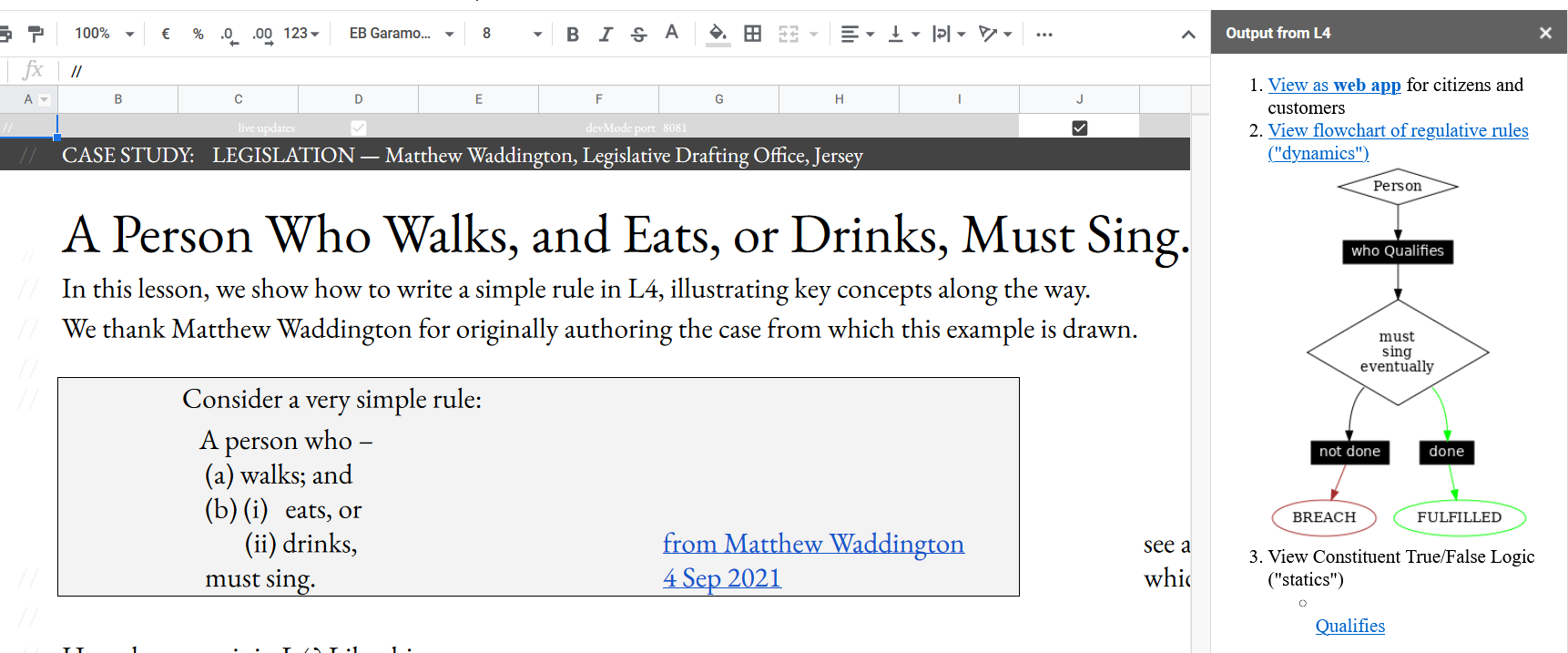
L4’s visualizers graphically depict the rules and logic of legal code to aid comprehension. (See: the ‘Must Sing’ example for ; or the ‘Home Insurance’ example)
L4’s scenario explorer helps engineers and end-users explore a contract by asking “what if?” and “can I?”.
L4’s explanation engine offers justifications for verdicts calculated by L4, for transparency.
L4’s planning engine helps end-users achieve goals by asking “how to?”.
L4 helps legal engineers draft with confidence
L4 is a DSL: a “low-code” domain-specific language designed for the legal domain.
The L4 ecosystem of tools, libraries, and sample code helps legal engineers get productive quickly without reinventing the wheel.
L4’s drafting IDE helps legal engineers draft and amend legal code with confidence, in a low-code programming environment, using techniques borrowed from programming language theory, compiler design, and formal methods.
L4’s ergonomic syntax is expressive enough to encode any contract and legislation using familiar keywords and a natural-language syntax
L4’s app builder automates the extraction of LegalTech apps without having to hire a team of developers for efficiency.
L4’s transpiler exports to a variety of third-party tools and languages for interoperability.
L4 helps enterprises manage their contracts
Enterprise users can integrate L4 into their existing contract lifecycle management systems to support more sophisticated “what if?” queries than their CLM databases allow.
L4 helps governments streamline service delivery
Government agencies innovating with “Rules as Code” can use L4 basis for automating the generation of citizen-facing web applications and chatbots.
L4 helps laypeople with a Web App
L4 automatically generates a web app that helps end users explore the logic of your legal code.
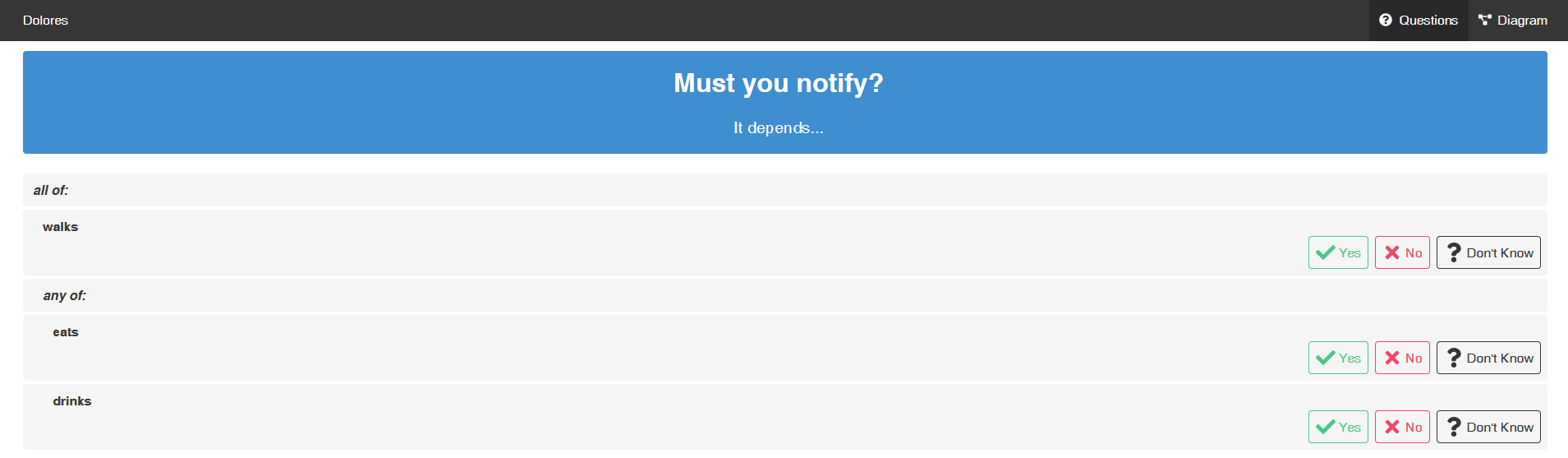
They can use this tool to understand if a law applies to them, or certain contractual conditions are met.
L4 helps you detect conflicts and loopholes
L4 sanity-checks your programs to detect internal conflicts and loopholes.
The “formal methods” components of the L4 toolchain automatically analyze your code for loopholes and inconsistencies.
L4’s unit testing framework lets you set up test scenarios and monitor them as your contracts evolve.
L4’s library of components makes it easier to draft legal templates and automatically produce legal documents for signature.
L4 helps you visualise legal logic
L4 generates convenient visualisations of the logic and the moving parts of your “legal program”.
To understand complicated logic involving words like “and”, “or”, “unless”: view the circuit diagram to see how yes/no verdicts depend on input facts.
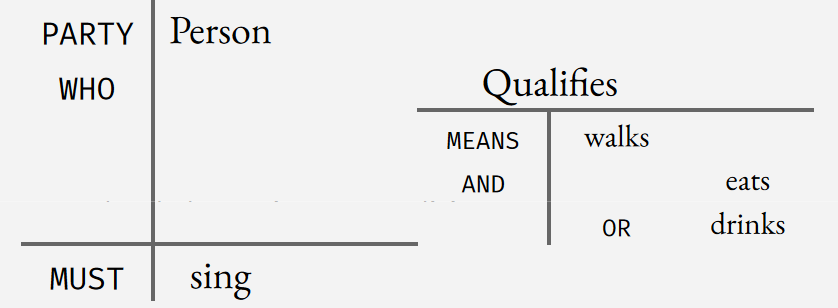
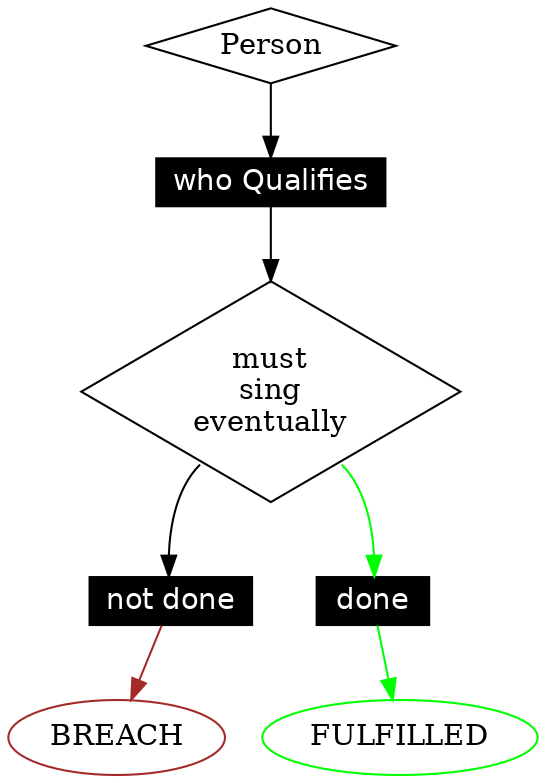
To understand complicated processes involving deadlines and obligations: view the state diagram to see how events change state over time, leading to new obligations for parties. Identify a goal and see what you need to do to achieve it.
To understand complicated rule interactions like notwithstanding, subject to: view the meta-rule analysis to see how rules interact. (in development)
L4 can export to multiple formats
L4 code can be exported to languages such as Typescript (Javascript), Python, Prolog, and Haskell.
On the roadmap are other languages like OpenFisca, Catala, Epilog, and Accord. We prioritize these exporters according to demand so if there’s something you want on the list please contact us!
L4 uses spreadsheets for interaction
L4 is low-code. You don’t have to install VS Code, Emacs, or Vim. The IDE is Google Sheets: if you can edit a spreadsheet, you can program in L4.
L4 contains a package library
The L4 package library (currently in development) contains useful components such as
Calendars (knows about holidays, can count business days)
Money (knows about currencies)
Corporate (knows about directors, shareholders, meetings, resolutions)
Investment Agreements (convertible notes, SAFEs, and other instruments)
Insurance Policies (knows about risks, coverage, and supplementary add-ons)
Legislation and Regulation (knows about permitting and compliance)
L4 supports Document Assembly
The contract assembly engine helps you generate a document you can sign after running it past a lawyer for code review.
For investment agreements, L4 also generates all the prerequisite components such as board resolutions and members’ resolutions in writing.
L4’s PDF documents embed the code of the L4 contract for forward compatibility with contract lifecycle management tools.
The L4 package library will soon contain loan agreements, leasing agreements, and investment agreements.
L4’s answers are explainable
L4’s answers are explainable and transparent.
You can ask “why?”: Interactively drill down into every decision.
You can ask “how?”: if you state a goal you want to achieve, L4 will outline a course of action.